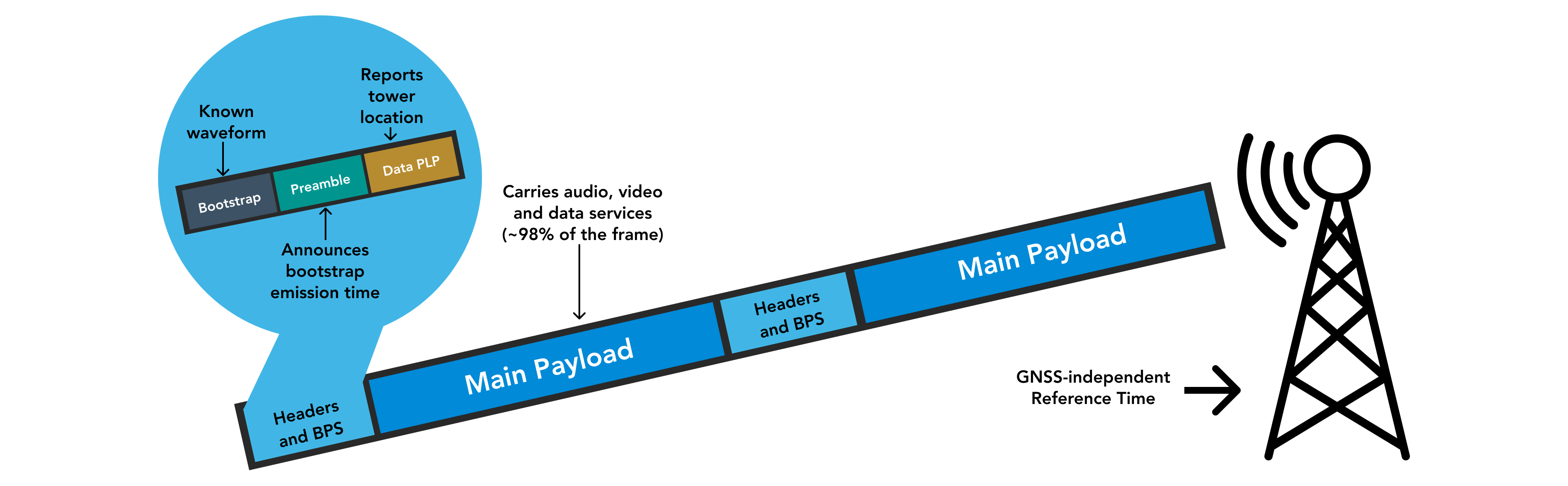
Broadcast Positioning System (BPS) uses ATSC 3.0 broadcast transmissions to deliver precise timing and positioning signals. Resilient by design as a self-synchronizing network, it leverages existing broadcast towers and infrastructure to make a cost effective, timely, and nationwide deployment possible.
With BPS, every ATSC 3.0 frame carries an emission time and the transmit-antenna location. A BPS receiver at a known location derives time by subtracting the propagation delay. The system operates on a broadcast TV channel and does not require an uplink, cellular connection, or GNSS signal.
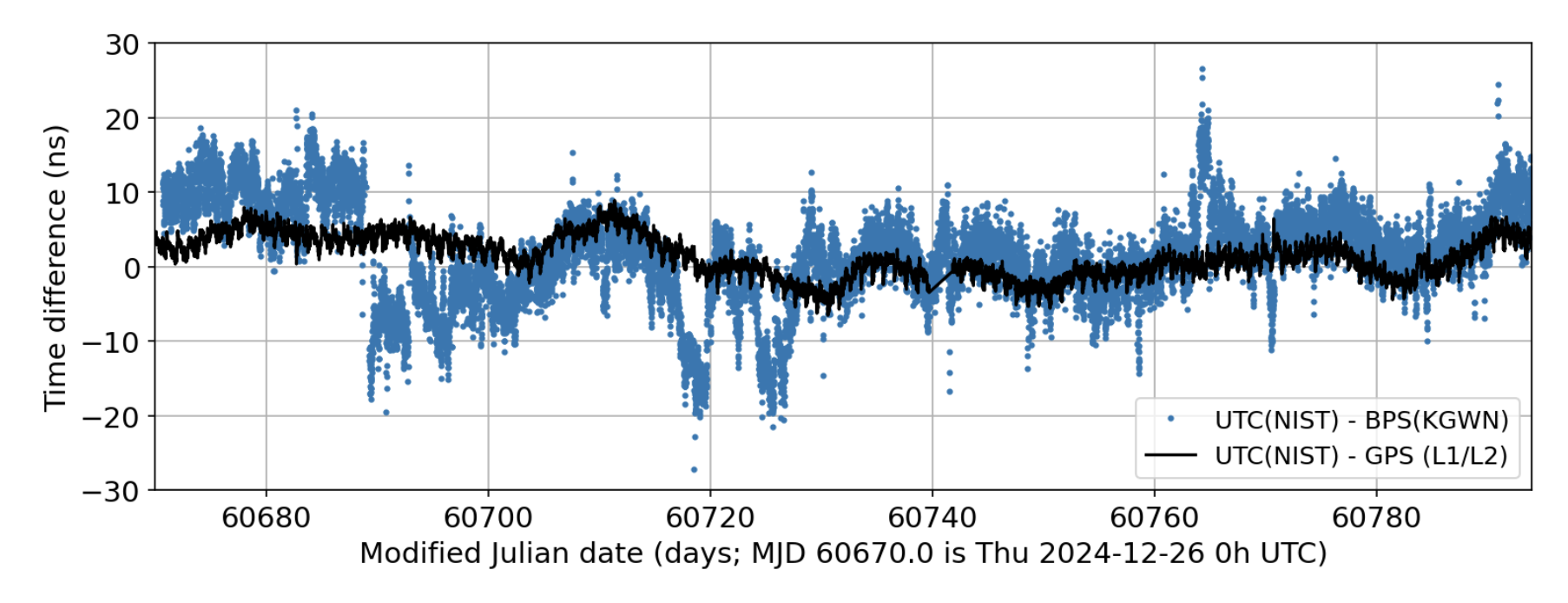
A BPS time transfer study conducted by NIST and published in the ION ITM and BEITC proceedings revealed that the time deviation (TDEV) statistics are less than 1 ns and 4 ns for 1-day and 1-week averaging intervals respectively.
The following plot shows time interval error (TIE) measured at NIST for a 30 km non-line-of-sight (NLOS) propagation path over four months.
The technical foundations behind BPS are public and peer-reviewed. Selected papers and recorded technical sessions below.
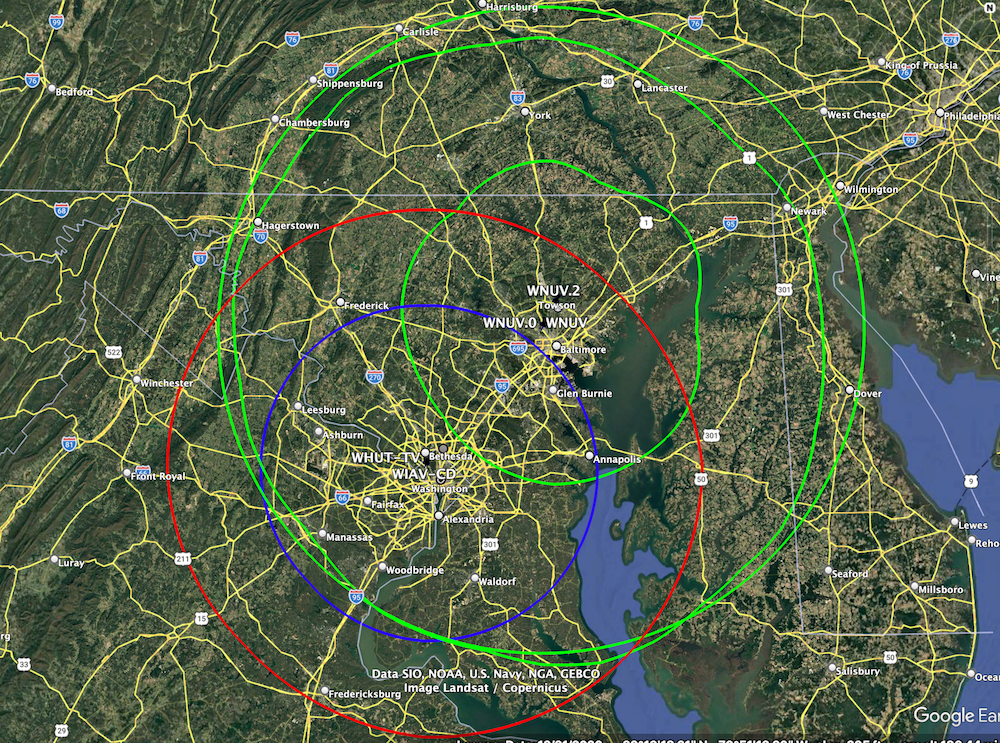
Merkhet Solutions is currently operating and expanding a BPS network in the DMV (Washington D.C., Maryland and Virginia) area to engage with Critical Infrastructure operators, government agencies, and other partners.